

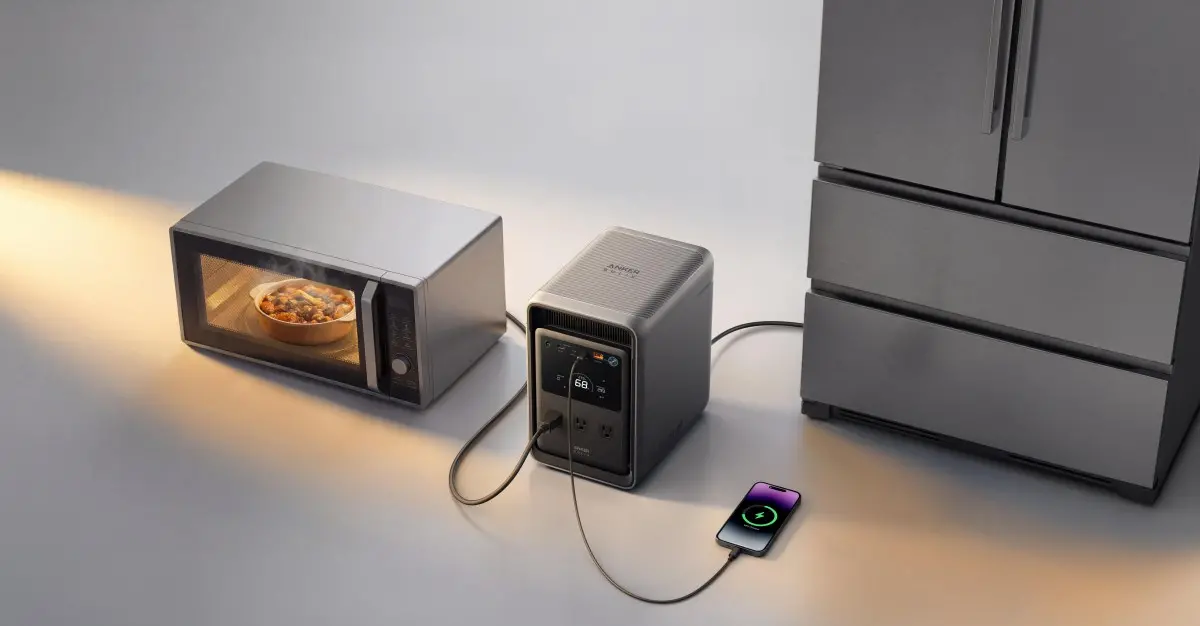
Portable power stations have become essential gear for vanlifers, tailgaters, job sites, and home backup during outages. But for all their convenience, many suffer from two hidden flaws: idle power draw that silently drains the battery, and an oversized footprint that eats up precious space. Anker’s new Solix S2000 directly addresses both problems, offering a smart, compact, and affordable solution that could reshape the mid-range power station market.
The Solix S2000 is a 2kWh (2048Wh) lithium iron phosphate (LFP) power station with a continuous 1500W AC inverter (3000W surge). LFP chemistry is already favored for its long cycle life and safety, but Anker has gone a step further by tackling the phantom load that plagues most competitors. According to the company, the S2000 consumes only about 6 watts when idle—far less than the 30W or more typical of comparable models from EcoFlow, Bluetti, or Jackery. That means you can leave the AC output switched on for nearly two weeks before the battery is depleted, compared to just a few days with many rivals.
How Anker Achieves Ultra-Low Idle Draw
The secret is Anker’s proprietary “OptiSave” technology, which optimizes the inverter’s standby circuitry. Most power stations use high-power inverters (2400W and up) that require significant energy just to stay ready. By choosing a 1500W inverter—still ample for most household appliances—Anker reduces that baseline overhead. The tradeoff is that you won’t be able to run multiple high-draw devices simultaneously, but for a typical camper or home backup, 1500W is plenty. It can handle a refrigerator, CPAP machine, lights, and phone charging all at once. Even a hair dryer can run for short bursts thanks to the 3000W surge capability.
Idle power draw is often overlooked by buyers, but it’s a critical spec for those who rely on a power station as a standby emergency unit. If a storm knocks out your grid power, you want your battery to be as full as possible—not depleted by its own electronics. Anker’s approach gives users peace of mind that the S2000 will be ready when needed, not dead on arrival.
Smaller Footprint, Higher Energy Density
The second major pain point Anker addresses is size. The Solix S2000 measures 208 x 282 x 323 mm—about the size of a small cooler—and weighs 35.7 pounds (16.2 kg). That gives it an energy density of roughly 106 Wh per liter, beating bulkier 2kWh units like the EcoFlow Delta 2 Max (which is taller and heavier) and the Bluetti AC200L (which is larger overall). For vanlifers and RV owners where every square inch counts, this compact form factor is a huge advantage.
Part of the space savings comes from a thoughtfully arranged internal layout. The battery cells, inverter, and control board are all densely packed, and the casing has no unnecessary protrusions. Anker also placed AC outlets on both the front and back panels, so you don’t have to move the unit to plug in devices from different directions—a small but welcome convenience when the station is tucked into a cabinet or under a seat.
Ports, Solar Input, and Expandability
The S2000 offers a solid selection of ports: three AC jacks on the front, two on the back, two USB-C (each up to 100W), one USB-A, a 12V car outlet, and a dedicated solar input rated at 400W. The USB-C ports can fast-charge laptops and tablets, making the station suitable for remote work. The solar input supports up to 400W of panels, which can recharge the battery in about 5–6 hours of good sunlight—ideal for off-grid use.
Anker has not confirmed whether the S2000 can be expanded with extra battery packs, a feature found on some competitors. However, the existing capacity of 2kWh is sufficient for most single-day needs, such as keeping a refrigerator running for 24+ hours, powering a CPAP machine for several nights, or providing juice for lights and electronics during an outage.
Launch Pricing and Availability
Anker is aggressively courting early adopters with a preorder price of just $599 before June 1, 2026. That works out to about $0.29 per watt-hour, which is exceptionally low for a 2kWh LFP power station. After the promotional period, the price will climb to $679.99, with a possible MSRP as high as $1,199.99 depending on discounts. EU pricing and shipping dates are expected in the coming weeks. Given the specs and the company’s reputation, the S2000 represents one of the best value propositions in the category right now.
Comparison with Competitors
In the same 2kWh class, the Anker Solix S2000 competes directly with the EcoFlow Delta 2 Max (2048Wh, 2400W inverter, ~30W idle draw), Bluetti AC200L (2048Wh, 2400W inverter, ~25W idle), and Jackery 2000 Plus (2160Wh expandable, 3000W inverter, ~35W idle). While those units offer higher continuous power output and sometimes expandability, they all suffer from significantly higher idle consumption and larger physical footprints. Anker has deliberately traded peak wattage for efficiency and size.
For users who need to run power-hungry tools like circular saws or air conditioners, a 2400W+ inverter may still be necessary. But for the vast majority of camping, van-life, and home backup scenarios—refrigerators, fans, laptops, lights, phone chargers, even small microwaves—1500W is more than adequate. The lower idle draw also means less energy wasted, so the usable capacity of the S2000 effectively exceeds that of its peers over a multi-day period.
Early Reviews and Build Quality
Early hands-on impressions from US tech reviewers are positive, praising the build quality, the quiet operation of the fan, and the intuitive display. The unit’s casing feels robust, with a textured surface that resists scratches. The LCD screen shows remaining battery percentage, input/output wattage, and estimated runtime—standard but well-implemented. Anker has also included a carrying handle that makes the 35.7-pound unit reasonably portable, though you won’t want to carry it long distances.
Anker’s warranty and customer support have historically been solid, which adds confidence for long-term ownership. The LFP battery is rated for 3,500 cycles to 80% capacity, effectively lasting over a decade of daily use.
Who Should Buy the Solix S2000?
The primary audience is vanlifers and RV owners who are space-constrained and need a reliable power source that won’t die overnight. Homeowners seeking a backup for short power outages will also appreciate the low idle draw, as the station can sit plugged in for weeks without worrying about a dead battery when a storm hits. Campers who run a moderate amount of electronics—fridge, lights, fans, laptops—will find plenty of headroom. The $599 early-bird price makes it a no-brainer for anyone in the market for a portable power station in this capacity range.
The only notable omission is a 30A RV outlet (TT-30R), which some competitors offer. However, for most 15A or 20A applications, the S2000’s standard NEMA 5-15R outlets suffice with an adapter. Also, the lack of an expansion battery option may be a dealbreaker for those who anticipate needing more than 2kWh regularly. That said, for the price and the features, the tradeoffs are minor.
Source: The Verge News