

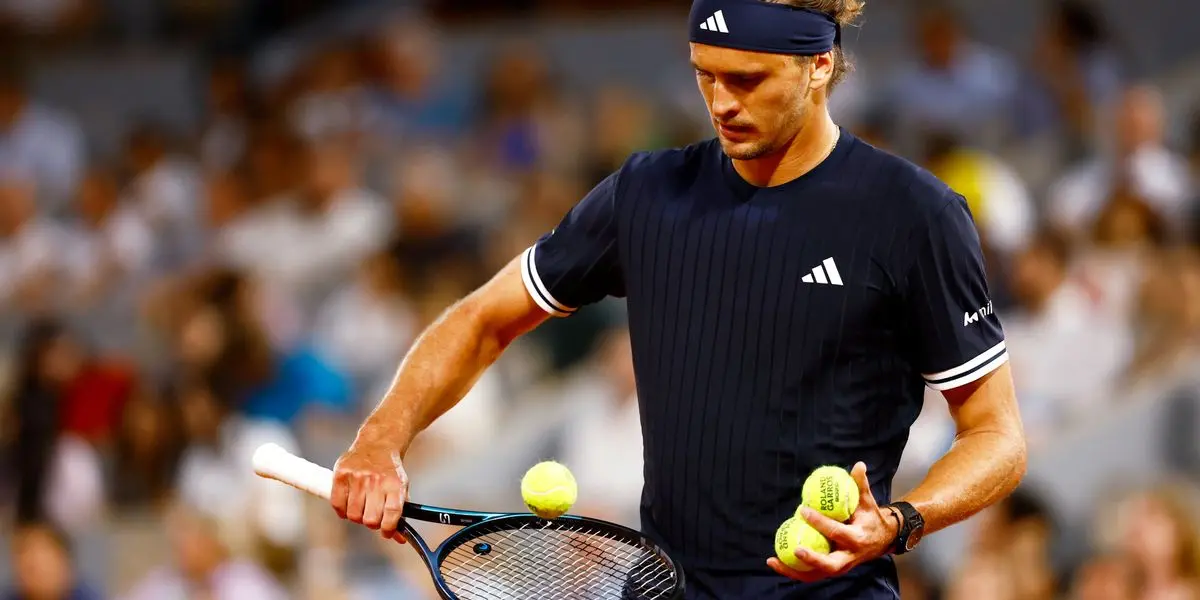
Alexander Zverev has made a habit of simplifying the complex. At the French Open, where small adjustments can mean the difference between a title run and an early exit, the world No. 3 refuses to engage in one of tennis’s most persistent debates: the feel of the ball. After a commanding 6-4, 6-2, 6-2 victory over Czech qualifier Tomas Machac in the second round, Zverev revealed that he pays no attention to the subtle differences in tennis balls that often preoccupy his peers.
“I just take the first one I get, try to serve as hard as I can, and win the point,” Zverev said with a shrug. “That’s it.” The comment came in response to a question from former world No. 1 Mats Wilander, who noted that Zverev barely inspects the balls before serving. While players like Novak Djokovic and Rafael Nadal are known for meticulously selecting balls, Zverev treats them as interchangeable. “Maybe I’m too stupid to tell the difference,” he joked. “But for me, they are all the same.”
The Ball Debate at Roland Garros
The subject of tennis balls has been a recurring theme at this year’s French Open. In 2023, several players complained that the new Wilson balls used at the tournament were heavier and more prone to fluffing up, affecting spin and speed. Nadal, a 14-time champion in Paris, has historically been vocal about ball quality, while Djokovic has also weighed in on the inconsistency. The balls’ condition can influence serve speed, rally length, and even injury risk. Yet Zverev remains blissfully indifferent. “I’m lucky I don’t sweat much,” he added, explaining why he rarely uses a towel between points. “It’s just not something I need.”
Zverev’s approach is not entirely without logic. Tennis balls are standardized by the International Tennis Federation (ITF) for diameter, weight, and bounce. The differences between individual balls within a can are minimal, often within a few grams or millimeters. While top players claim they can detect variations in felt density or internal pressure, studies suggest that these differences are negligible for most players. Zverev’s success suggests that overthinking can be counterproductive. “If you worry about the ball, you lose focus on the shot,” said former coach and analyst Brad Gilbert. “Zverev’s mentality is refreshingly straightforward.”
A Dominant Performance
On the court, Zverev’s carefree attitude translated into a ruthless display of serving. He fired 19 aces, won 84 percent of his first-serve points, and did not face a single break point. Machac, ranked 43rd, had no answer to Zverev’s pace and precision. The German broke serve three times in the first set alone, dictating rallies with his powerful groundstrokes. “I felt good from the start,” Zverev said. “The court was fast, and I was able to take control early.”
Zverev is seeking his first Grand Slam title after coming close on several occasions. He reached the US Open final in 2020, where he led Dominic Thiem by two sets before losing in five. He also made the semifinals at Roland Garros in 2022 and 2023, falling to Nadal and Casper Ruud respectively. The 27-year-old Hamburg native has often been criticized for lapses in concentration, but this season he has shown renewed maturity. Under coach Alexander Vasiliev, Zverev has improved his fitness and mental resilience. His second-round performance was a testament to that growth.
Machac, 24, is considered one of the rising talents on the ATP Tour, with a notable win over Andrey Rublev earlier this year. But he was overwhelmed by Zverev’s firepower. The match lasted just over two hours, with Zverev winning 98 of the 148 points played. “He was just too strong today,” Machac admitted. “I had no chances on his serve.”
The Psychology of Simplicity
Zverev’s comments also highlight a broader psychological trend in tennis. The sport has become increasingly data-driven, with players analyzing every variable from string tension to ball composition. Yet the elite often succeed by filtering out noise. Roger Federer was known for his relaxed demeanor, while Serena Williams often emphasized feeling over analysis. Zverev appears to be taking a similar path. “If you watch the greatest players, they make the game look simple,” said ESPN analyst Patrick McEnroe. “Zverev has that ability when he’s dialled in.”
Not everyone agrees with his methods, though. Some coaches argue that ignoring ball differences is a missed opportunity. “Every advantage counts at the highest level,” said fitness trainer Mark G. “If a ball is fluffier, you might want to spin it more; if it’s crisp, you can hit flat. Zverev is leaving that on the table.” Still, the results speak for themselves. Zverev has won 20 of his last 24 matches on clay, including a title run in Rome last month. He is currently second in the ATP Race to Turin, trailing only Novak Djokovic.
Upcoming Challenge
In the third round, Zverev will face Frenchman Quentin Halys, a big server who will look to challenge Zverev’s return game. Halys, ranked 72nd, upset 15th seed Ben Shelton in the first round and backed it up with a straight-sets win over Francisco Cerundolo. The match promises to be a test of Zverev’s focus and adaptability. “Playing a home player is always tough,” Zverev noted. “But I’m ready for it. I have a lot of support here, too.”
Beyond the immediate match, Zverev’s path to the title could include meetings with Jannik Sinner, Carlos Alcaraz, or Novak Djokovic. For now, he remains grounded. “I don’t look too far ahead,” he said. “One match at a time.” And as long as the balls keep flying in, he likely won’t care which ones he uses.
Source: Spiegel News