

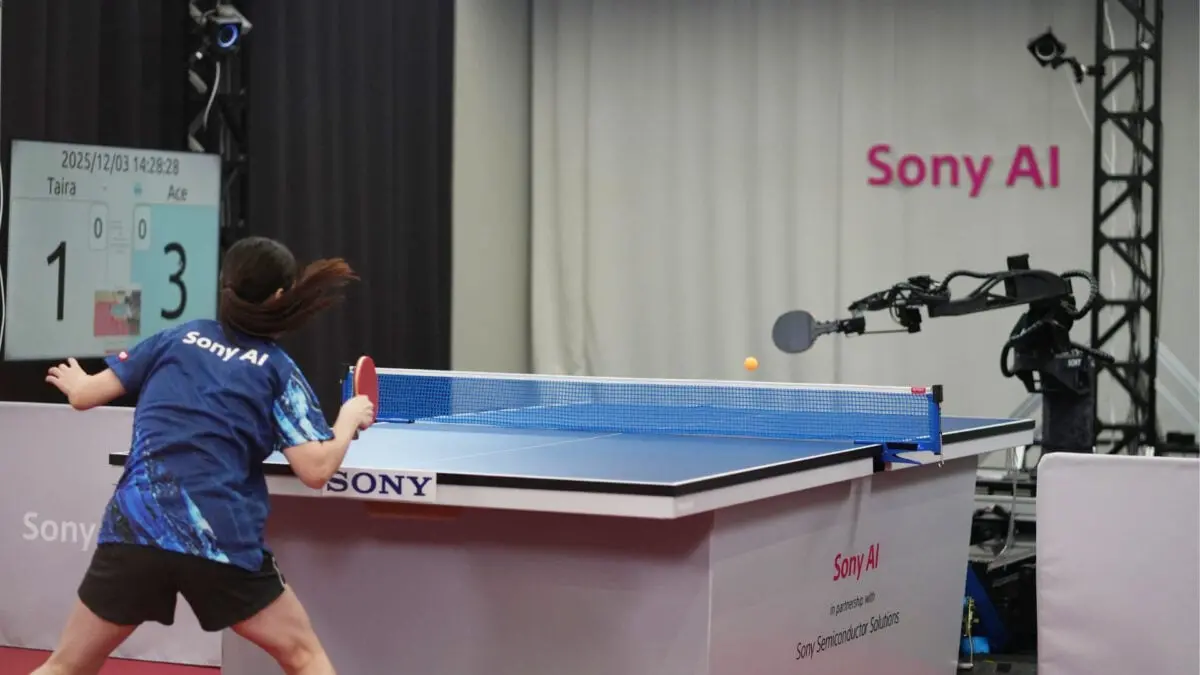
The world of competitive table tennis has a new contender—one that doesn't require a paddle in its hand but rather a suite of sensors and algorithms. Scientists at Sony's AI division have developed an autonomous robotic system named Ace, which can match and even defeat elite human players. Research published in the journal Nature details how Ace won a majority of its matches against experienced table tennis players, though it initially fell short against top professionals. Over subsequent test sessions, the robot improved significantly, eventually defeating a player ranked among the top 25 in the world.
Ace represents a landmark achievement in the intersection of artificial intelligence and robotics. While AI systems have long surpassed humans in digital games like chess and Go, physical sports pose unique challenges. Table tennis demands split-second reactions, precise coordination, and the ability to generate and respond to high-speed spins. The robot's success demonstrates that AI can now operate effectively in the physical world, where perception, control, and agility must come together in real time.
The Rise of Ace
The project began as a research initiative at Sony AI, the company's dedicated AI research division. The team, led by principal scientist Peter Dürr, aimed to push the boundaries of what physical AI agents can achieve. Unlike simulated environments where AI can rely on perfect information, real-world table tennis involves noisy sensor data, unpredictable human behavior, and rapidly changing dynamics. Ace was designed to tackle these challenges head-on.
The robot itself is a custom-built system featuring a high-speed camera array, a robotic arm with six degrees of freedom, and a specialized paddle. The control system uses deep reinforcement learning to continuously improve its play. During training, Ace played millions of simulated matches against virtual opponents before being tested against humans. The real-world testing was conducted under official International Table Tennis Federation (ITTF) rules, with licensed umpires overseeing the games—a first for robotic table tennis research.
Technical Challenges Overcome
Table tennis is notoriously difficult for robots. The ball can reach speeds of over 100 kilometers per hour, and spin rates exceed 100 revolutions per second. Detecting the ball's trajectory and spin from visual data alone requires advanced computer vision. Ace uses a multi-camera setup that captures images at 1,000 frames per second, allowing it to track the ball's position and orientation with millimeter precision. The robot then predicts the ball's future path and calculates the optimal return stroke within milliseconds.
One of the biggest breakthroughs was the development of a spin estimation algorithm. Human players rely on cues like the opponent's paddle angle and arm motion to anticipate spin. Ace learned to infer spin from the ball's visual appearance—specifically, the pattern of the ball's surface markings. This allowed the robot to consistently return high-spin serves that would stump earlier systems. The researchers also fine-tuned the robot's ability to generate its own spin, enabling it to produce aggressive shots that challenge human opponents.
Performance Against Human Players
The study, conducted in April 2025, pitted Ace against five elite players—amateurs with at least 10 years of experience who train 20 hours per week on average. Ace won three of five matches. The robot also faced two professional players from Japan's table tennis league, Minami Ando and Kakeru Sone. Ace managed to win one game against a pro but ultimately lost both full matches. However, a follow-up session in December 2025 showed dramatic improvement: Ace defeated both elite and professional players, including a win over a pro. By March 2026, Ace had won three professional matches, one against Miyuu Kihara, who at the time was ranked in the top 25 in the World Table Tennis women's singles rankings.
The robot's performance was not just about winning—it also displayed increasingly sophisticated tactics. In later matches, Ace began targeting the table edges with faster, more aggressive shots, a strategy that exploits human limitations in lateral movement. The robot's reaction time, at around 50 milliseconds, is faster than the average human's 200 milliseconds, giving it an edge in rallies that require rapid returns.
Implications for Robotics and AI
While Ace's primary purpose was research, the technologies developed have broader applications. The real-time perception and control systems could be adapted for industrial automation, where robots must handle unpredictable objects with speed and precision. The spin estimation algorithms might improve robotic manipulation in tasks like sorting produce or assembling delicate components. Additionally, the work contributes to safe human-robot interaction, as Ace operates in close proximity to human players without causing injury—a critical requirement for collaborative robots.
Peter Dürr noted that the project was designed to study how AI could operate safely and effectively in the physical world. The challenges of table tennis—adversarial human interaction, noisy sensors , and the need for split-second decisions—mirror those in many real-world domains. The team believes that the lessons learned from Ace will inform the development of robots for sports training, entertainment, and even emergency response where quick physical responses are crucial.
Future Directions
The research team is continuing to refine Ace's capabilities. Future enhancements may include improved footwork (the robot currently uses a fixed base but can pivot), better handling of extreme spins, and adaptation to different table tennis styles. The team also plans to test Ace against even higher-ranked professionals, potentially including top 10 players. Additionally, the underlying AI framework could be generalized to other sports, such as badminton or tennis, which share similar physical demands.
For now, Ace stands as a testament to the progress in embodied AI. The robot's ability to hold its own against elite human players—and even win against a top 25 professional—marks a milestone in robotics. It suggests that the gap between human and machine performance in physical sports is narrowing, opening up new possibilities for human-robot collaboration and competition.
Source: Gizmodo News