

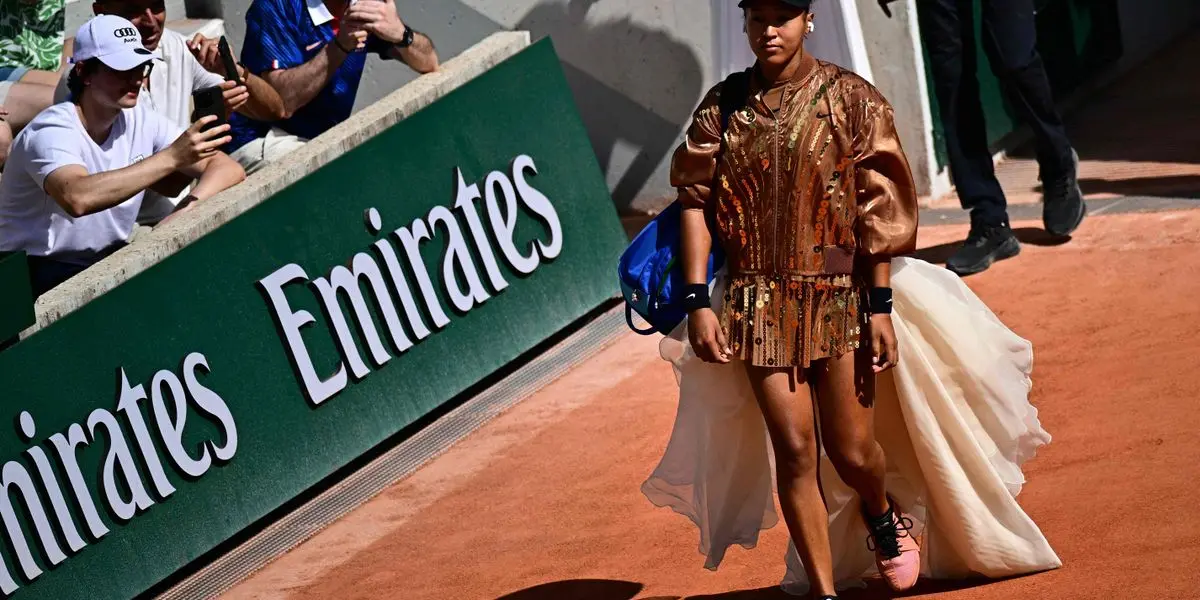
The French Open witnessed another unforgettable entrance as Naomi Osaka glided onto Court Simonne-Mathieu in a cream-colored gown with a flowing train. The crowd erupted in applause as the former world number one prepared to face Croatia's Donna Vekić in the second round. It was a moment that blended high fashion with high-stakes tennis, a signature of Osaka's comeback journey.
Osaka's outfit consisted of a long-sleeved lace top paired with a full-length skirt that featured a dramatic train trailing behind her. She accessorized with minimal jewelry, letting the design speak for itself. This followed her first-round appearance where she stunned in a black floor-length dress, which she removed before warming up, revealing a sparkling metallic outfit underneath.
The 28-year-old Japanese star defeated Vekić 7-6, 6-4 in a hard-fought match, advancing to the third round. Her performance on court was as impressive as her pre-match style, with powerful serves and relentless baseline rallies that kept the Croatian off balance. The win marked another step in Osaka's return to form after taking time off for the birth of her daughter in 2023.
The Fashion Debate
Osaka's sartorial choices have not gone unnoticed by her peers. After their first-round match, German player Laura Siegemund expressed frustration, stating, "She comes here to play tennis, not to have a fashion show." Siegemund, who lost to Osaka, implied that such dramatic entrances should be scrutinized for rule compliance, particularly regarding time violations. "If others want to do that, it's okay for me, but there should be every second watched during such entrances. That's the only thing about the rules that I don't find okay," she added.
Osaka responded with characteristic poise and insight. "Sporters are in the show business," she said after her win over Siegemund. "The entrances at Grand Slam tournaments are the only moments where I feel maybe like an entertainer." This statement captures the tension between athletic purity and entertainment value that has long existed in tennis. Osaka sees no conflict; rather, she embraces the opportunity to express herself within the sport's traditions.
The debate highlights a broader discussion about the role of fashion in tennis. Traditionally, all-white dress codes at Wimbledon enforced a strict uniformity, but other tournaments have relaxed rules, allowing players to showcase personal style. Osaka's choices push these boundaries further, turning the walk from locker room to baseline into a performance in its own right.
Osaka's Career and Comeback
Naomi Osaka is no stranger to the spotlight, both for her tennis achievements and her off-court activities. She has won four Grand Slam titles: the US Open in 2018 and 2020, and the Australian Open in 2019 and 2021. Her powerful serve and aggressive baseline game made her a dominant force on hard courts. However, she struggled on clay; reaching the third round in Paris is a solid result for her given her preference for faster surfaces.
Osaka's career has been marked by periods of break and reflection. In 2021, she withdrew from the French Open after a mental health controversy, sparking a global conversation about athletes' wellbeing. She later took a hiatus from tennis, giving birth to her first child in 2023. Her return to the sport has been met with enthusiasm, and her fashion choices seem to reflect a newfound confidence and joy in competing.
At the 2024 Australian Open, Osaka already turned heads with a custom Nike outfit featuring a cropped top and skirt with bold color blocks. She has consistently used clothing to make statements, whether about her heritage, feminism, or personal taste. Her collaboration with French brand Louis Vuitton has further cemented her status as a fashion icon.
Historical Context of Tennis Fashion
Tennis has a rich history of fashion innovation. In the 1920s, Suzanne Lenglen shocked Wimbledon with her sleeveless dresses and headbands. In the 1970s, Billie Jean King wore custom floral dresses, and later Serena Williams brought catsuits and tutus to the court. Osaka's cream train evokes the glamour of old Hollywood while pushing into contemporary design.
The International Tennis Federation rules regarding on-court attire are relatively permissive, barring only offensive imagery or excessive logos. However, tournaments like Wimbledon enforce strict all-white rules, which have been challenged by players like Andre Agassi (denim shorts) and Venus Williams (lace). Osaka's entrances are perfectly legal, focusing on the walk rather than play. Yet Siegemund's comments hint at a gray area: could a slow entrance be penalized under the time rule? Officials have not intervened, suggesting that while the debate is lively, enforcement remains lenient.
Fashion in tennis also serves as a form of self-expression and branding. Players earn significant endorsement income from apparel deals. Osaka's partnership with Nike includes a line of signature outfits. Her train was likely designed to be dramatic yet lightweight, allowing easy removal before the match. This interplay between performance and presentation defines modern sports marketing.
Show Business in Sports
Osaka's quote about being an entertainer resonates beyond tennis. In the era of social media and 24/7 sports coverage, athletes are increasingly expected to be personalities as well as performers. LeBron James, Cristiano Ronaldo, and Megan Rapinoe have built platforms that transcend their sports. Osaka, with her multicultural background, advocacy for social justice, and fashion-forward image, exemplifies this trend.
The French Open provides a particularly glamorous backdrop for such displays. Known for its red clay, elegant stadiums, and celebrity-studded crowds, the tournament attracts fashion-forward fans. The walk from the locker room to the court, often through tunnels and corridors, becomes a miniature catwalk. Osaka's entrances have garnered millions of views online, driving engagement with the tournament.
Critics like Siegemund argue that tennis should remain purely about athletic competition. But the reality is that sports have always been entertainment. The roar of the crowd, the drama of a tiebreak, the visual delight of a well-struck shot — these are all elements of a show. Osaka's train does not distract from her tennis; it adds a layer of spectacle that enriches the experience for everyone.
Her match against Vekić was a testament to her focus. After the initial applause, she shed the train, donned her hitting outfit, and immediately broke serve. The crowd stayed with her throughout, appreciating both her style and her skill. She held her nerve in the tiebreak and closed out the second set with a powerful ace.
As Osaka continues her quest for a first French Open title, she carries not just a racket but also a wardrobe that tells a story. Each outfit is a chapter — the black dress of resilience, the cream train of elegance, the glitter of celebration. She is rewriting the script of what it means to be a tennis player in the 21st century, one stylish entrance at a time. Her next match will surely be watched with anticipation not only for the tennis but for the fashion statement she will make next.
Source: Spiegel News