

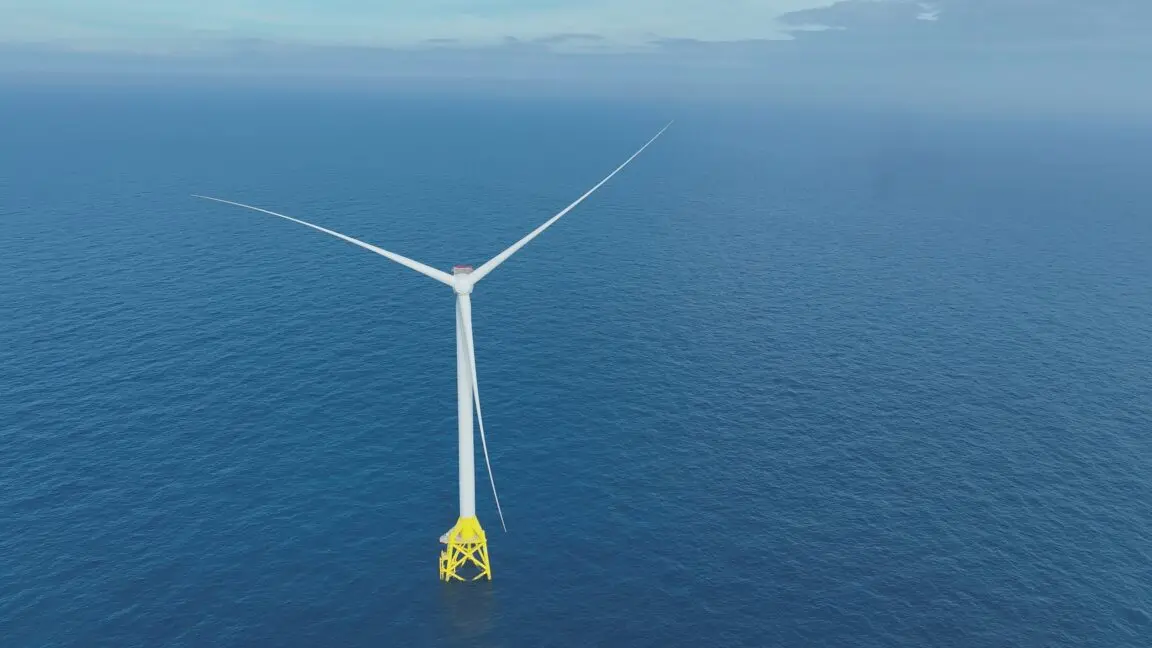
Taiwan Semiconductor Manufacturing Co. (TSMC), the world's leading advanced chipmaker, is reaping record profits from the artificial intelligence boom. But it is also racing to secure clean energy for its sprawling fabrication plants, signing a 30-year corporate power purchase agreement (PPA) to take 100% of the output from the Hai Long offshore wind project. The deal, announced on April 30, 2025, covers more than 1 gigawatt of power capacity across three offshore wind sites off Taiwan's west coast in the Taiwan Strait. Once fully operational by 2027, the project could supply electricity equivalent to powering over one million Taiwanese households.
Key facts
- TSMC signed a 30-year PPA for 1+ GW of offshore wind power from Northland Power's Hai Long project.
- Taiwan relies on imported LNG for about half its electricity; reserves dropped sharply after Qatar's LNG production halted in March 2026 due to Iranian drone strikes.
- TSMC's energy use accounted for nearly 10% of Taiwan's total electricity in 2023, projected to reach 25% by 2030 as AI chip demand grows.
- The government aims for 15 GW of offshore wind capacity by 2035 and is restarting nuclear plants.
- TSMC targets 60% renewable energy for global operations by 2030 and 100% by 2040.
The global energy crisis has hit Taiwan especially hard. A Bloomberg report in April 2026 noted that when Qatar shut down its natural gas production after Iranian drone strikes damaged its facilities in March 2026, Taiwan lost one-third of its usual liquefied natural gas supply. Since the island generates about half its electricity from natural gas plants and typically holds only two weeks of fuel reserves, an energy crunch countdown began. Reuters reported that Taiwan's government staved off immediate shortages by turning to alternative suppliers like Australia and the United States.
At an energy forum on May 6, 2026, Taiwan's vice minister of economic affairs stated that the administration had secured enough oil and gas to operate normally through August and possibly September, according to Taiwan News. But the crisis is accelerating efforts to reduce reliance on imported fossil fuels, which meet nearly 97% of Taiwan's overall energy needs, according to the Global Taiwan Institute, a Washington, D.C.-based think tank. President Lai Ching-te's administration is restarting shuttered nuclear power plants and pushing to expand renewables, including a government plan to make 15 gigawatts of offshore wind capacity available by 2035.
TSMC's role in Taiwan's energy future
TSMC's influence on Taiwan's energy landscape is outsized. According to the International Energy Agency's report on energy and AI, the chipmaker's energy needs accounted for nearly 10% of Taiwan's total electricity consumption in 2023. As TSMC invests in more energy-intensive manufacturing—such as 3-nanometer and 2-nanometer processes—to meet global AI demand for advanced chips, that share could grow to nearly one-quarter of Taiwan's overall electricity usage by 2030, based on S&P Global estimates cited by Data Center Dynamics.
The Hai Long project is not TSMC's first foray into wind energy. In 2020, the company signed a PPA with Danish renewable energy firm Ørsted for 920 megawatts from the Greater Changhua offshore wind farm, expected to be fully operational later in 2026. In 2021, TSMC struck a deal with German developer WPD to develop more than 1 gigawatt of onshore and offshore wind power. These agreements align with TSMC's public goals: to source 60% of its global operations' energy from renewables by 2030 and 100% by 2040.
Broader context: AI boom and energy demand
The surge in AI chip demand is reshaping global energy markets. Companies like Nvidia, AMD, and Intel rely on TSMC's advanced nodes to produce the most powerful processors for training large language models and running inference. Data centers alone consumed about 1-2% of global electricity in 2022, but that figure could triple by 2030. TSMC's fabs, which run 24/7 in cleanroom environments, require enormous amounts of power for chip fabrication processes that involve hundreds of steps, including photolithography, etching, and deposition.
Taiwan's geographic vulnerability adds another layer. The island imports nearly all its fossil fuels, and its location in a seismically active zone makes energy infrastructure prone to disruption. The offshore wind push not only helps TSMC meet its renewable targets but also strengthens Taiwan's energy security by reducing dependence on imported LNG and oil. Meanwhile, the restart of idled nuclear plants—such as the Kuosheng and Maanshan stations—faces public opposition and technical challenges, but officials argue it is a necessary bridge to a lower-carbon future.
Global implications
TSMC's wind power investments are being watched closely by other major tech firms and semiconductor manufacturers. The chip industry accounts for roughly 0.5% of global electricity use, but its share is growing as fabrication plants become more complex. Intel has pledged to use 100% renewable energy by 2030, and Samsung is building solar and wind projects to power its fabs. But TSMC's scale—the company operates multiple gigafabs in Taiwan, plus new facilities in Japan, Germany, and the United States—makes its energy strategy a benchmark.
The Hai Long project is a public-private partnership that also benefits Taiwanese utility companies and grid operators. By locking in a 30-year PPA, TSMC provides the financial certainty needed for developers to invest in large-scale offshore wind, which requires billions of dollars upfront. Northland Power, the Canadian developer, expects the project to generate enough power to offset millions of tons of CO2 emissions annually. As the AI era accelerates, the relationship between chipmakers and renewable energy will only deepen.
Source: Ars Technica News